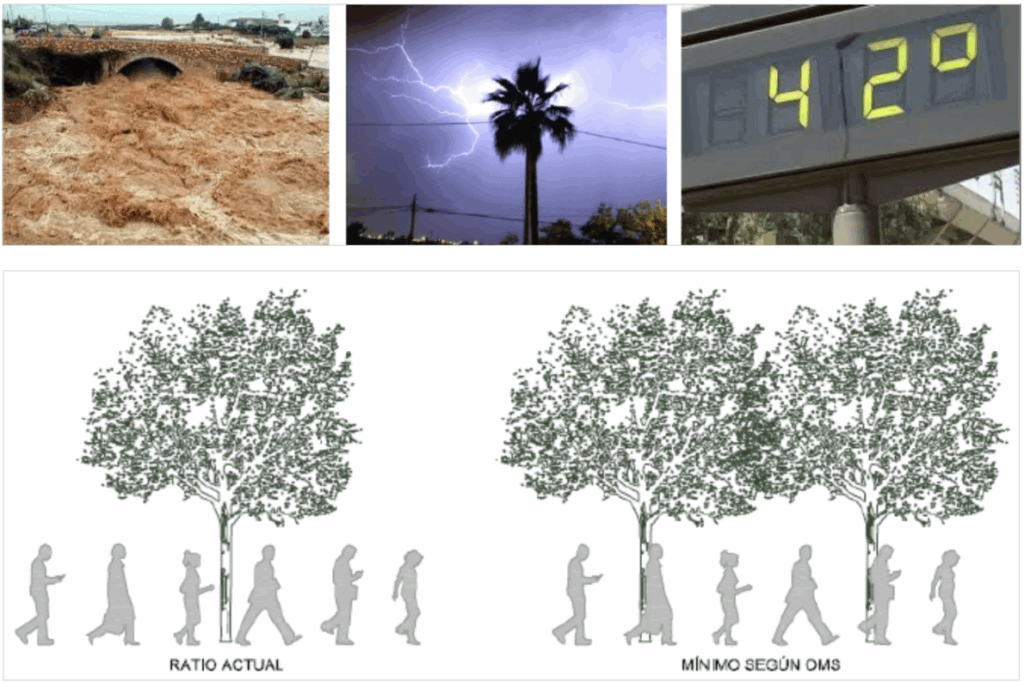
Sustainable urban development strategies have the objective of planning urban regeneration actions to face the challenges that arise and transform them into opportunities. The great challenges are related to adaptation to climate change, social cohesion and the integration of technology.
the objectives set by the UN in 2015 by adopting the 2030 Agenda For sustainable development, they have their continuity in the European agenda and are assumed in the Action Plan for the implementation of the 2030 Agenda of the Government of Spain.
The drafting of a regeneration plan reflects the need to have a global framework of reference that facilitates coordination between public and private activity, involving the different municipal areas, to achieve sustainable development goals in the whole of the territory.
It will define lines of action both for the urban fabric and for the rural environment, for the housing buildings and the facilities, the heritage and the landscape, placing in the foreground the territorial connections on all scales as well as the modes of growth and occupation of the land.
Regenerate happens by transforming, but above all by modifying habits and behaviors in the public and private sphere and also the relationship between the two, which cannot be reduced to citizen participation in the phase of detection of problems and elaboration of proposals. The training and information mechanisms that are put in place to build this administration / citizen relationship, constitute in themselves a regeneration strategy.
Strategic lines of urban strategy
The territorial development and well-being of its inhabitants will be linked in an unavoidable way to the sustainability of solutions, the adaptation to climate change and the approach of urban planning from a gender and inclusive perspective.
It will be necessary to undertake it in a transversal way in each of the strategies that are proposed and in each of the projects that are carried out, maintaining dynamics that allow updating the tools, evaluating results and incorporating new needs and new knowledge or techniques, when the processes are prolonged.
It is about using technology and data to improve the efficiency of urban services, avoiding the digital divide and ensuring that the ‘smart city’ is for the citizen.
Phases of the urban strategy
Strategic plans start with a Analysis and diagnosis phase which contains the synthesis of the problems and opportunities present in the municipal term, which allows the elaboration of the specific objectives aligned with the SDGs.
The study of quantitative data (demography, socioeconomic indicators, environmental metrics) is combined with a qualitative analysis of the territory. Meetings are organized with municipal technicians and participatory workshops with the local community to understand their needs, aspirations and perceptions. The result is a “opportunity mapping”: a visual and analytical document that identifies the challenges to be overcome and the latent assets.
The next is the Proposal phase where the lines of action and actions that specify the strategies to carry out the regeneration objectives throughout the municipal term are defined.
These are projects with a different degree of concretion depending on the municipality in question, but they serve all major strategic axes: built city efficient, accessible and balanced; mobility sustainable urban; RUrban Space ED sustainable and inclusive; prevention of risks and defense against climate change; development sustainable urban planning; protection and sustainable rural development
Among the proposed lines, we must address the hierarchy of actions that act as an engine, for example, for the regeneration of a neighborhood: the recovery of public space for areas of stay and relationship, the implementation of equipment that unites the population, the improvement of connections in active modes with others neighborhoods and services…
It is important to prepare a Evaluation plan, indicators and monitoring that serves to know the level of approach to the objectives set, through indicators aligned with the Spanish urban agenda and linked to the strategic and specific objectives of said Agenda. Contact us to expand the information.