The construction of the city generates projects of a different nature, being fundamentally of three types: building of a new plant, rehabilitations and adaptations of the public space.
To address these works, in all cases, we will start with the place and the elements that define their identity, because only their knowledge and consideration can guarantee the roots of the projected solution. at the same time, the customer It requires adapting the process in each case and personalizing it, to establish a productive relationship that benefits the quality of the result. economic viability It is a determining factor when designing solutions that should also fit the diverse current regulations and, very especially, to that related to the Sustainability of the processes.
The teams that participate in the drafting of the project and in its subsequent implementation, are multidisciplinary to meet the specific needs of design, structural calculations, installations, energy efficiency, etc. The architect assumes the coordination of all the content to guarantee its formal, functional and constructive coherence, as well as compliance with current legislation.
The basic methodology is adjusted in each case, depending on the characteristics of the work: public or private initiative, homes or buildings, building or rehabilitation, patrimonial recovery, adaptation of public space, among others.
Axes of action in architecture projects
The first axis of action is the Sustainability Environmental solutions: Consumer buildings almost zero, materials with low environmental impact and local origin, and renaturation of cities.
The second axis refers to the improvement of the quality of life of the inhabitants of the city. Quality environmental Respect for the biodiversity and conservation of urban ecosystems, increase in plant cover to mitigate the Isla Calor effect. Quality social and cultural Improving the relationship spaces, creating networks of accessible pedestrian itineraries that promote the meeting. Quality landscape which depends on both the buildings and the treatment of public spaces, trees and facilities. Quality ECONOMIC derived from energy saving and improving the health of the population.
build and conserve
In the case of new residential constructions, an analysis of the proposed needs and the new modes of coexistence that arise will be carried out, to leave behind obsolete typologies and propose versatile solutions, capable of adapting to the variety of users and the evolution of the nuclei of predictable coexistence.
The staffing buildings require an effort to make their public status visible, so that their image is part of the citizen’s identity and the user can use them safely and comfortably.
The aging of the urban environment and buildings built according to regulations that did not meet environmental criteria or minimum comfort, sometimes deteriorated due to lack of maintenance or obsolescence, require interventions for structural, energy rehabilitation and improvement of its accessibility. In many cases, urban regeneration interventions in vulnerable areas achieve the regeneration of the social fabric.
Protected assets or with patrimonial values initially pose more restrictive conditions that require an effort during the drafting of the project to reach a maximum adaptation to the quality standards required by the different regulations, while maintaining, and enhancing, the elements that are they intend to keep.
Urban space, focus of architecture projects
The adaptation of urban space is a fundamental piece in the regeneration of neighborhoods and in the transformation of cities for their adaptation to the climate crisis. Interventions in the public space must attend, from the design, the location and the management, to those factors that allow its use by all people, in a comfortable way and with the greatest possible degree of compatibility between the different individual or group circumstances.
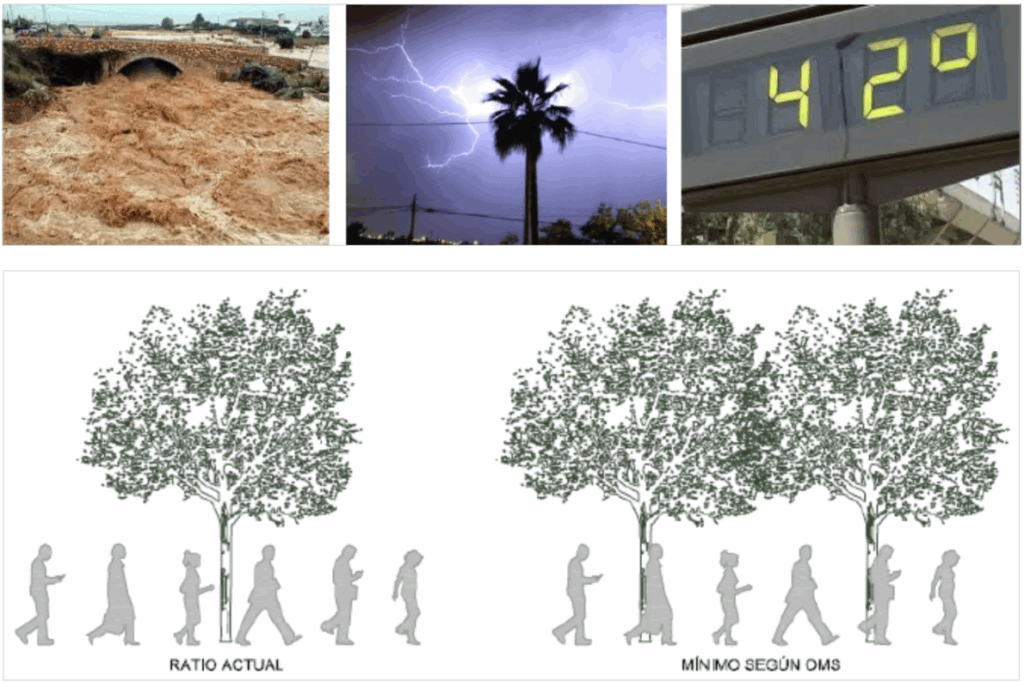
Plant treatment by increasing shade trees and plant mass contributes to sustainability and reduces vulnerability to increase in temperature. In our community, the need for sun protection is always raised so that walking or staying is possible outside, so it is necessary to provide the pedestrian routes with a greater number of trees, selecting species that guarantee the function of shadow and adapt to climate change.
Contact us to expand the information.